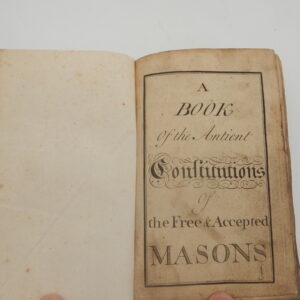
[ANDERSON, James]. ~ The Constitutions of the Free Masons. Containing the History, Charges, Regulations, &c. of that most ancient and right worshipful Fraternity. For the Use of the Lodges. Dublin: Printed by J. Watts, at the Lord Carteret’s Head in Dames-Street, for J. Pennell, at the three Blue Bonnets in St. Patrick’s-Street. In the Year of Masonry 5730. Anno Domini 1730.
8vo (182 × 100 mm), pp. [12], 96, complete with half-title, complete with folding engraved frontispiece. Title page slightly thumbed at lower forecorner. Contemporary sprinkled sheep, spine with five raised bands, lettered in gilt. Slightly rubbed, lettering indistinct. Early inscription to verso of title ‘Richard Dod His Book 1730’ to title verso, further early names to rear pastedown in early pencil and one ink pen-test. Modern bookplate of Patrick-André Chéné. An excellent, crisp copy in strictly contemporary state.
First Irish edition, published at the instigation of John Pennell, future Grand Secretary of the Grand Lodge of Ireland.
The exceptionally rare early Dublin edition reprints much of the first edition verbatim with some interesting additions and variants specific to Ireland. Firstly the dedication is to George Lord St. George of Hatley, Vice-Admiral of Connaught and governor of the city of Galway, recording his ‘tender Regard’ for the Masons. Secondly there is a list of 136 subscribers, most from among the merchant, gentry and military classes, representing an important source for the early history of Freemasonry in Ireland. Thirdly, the general history of Masonry given by Anderson is extended here with a digest of early Irish history listing notable instigators and builders of Irish churches and monuments, including Thomas Burgh and Captain Edward Lovet Pearce, the latter architect of the Irish Parliament House built in 1728-9. The engraved frontispiece is a slight reduction in reverse of John Pine’s plate for the first edition, engraved by Phillip Simms of Dublin
There are several smaller but more subtle variances from Anderson’s text, notably on the question of Masons’ relationship to religion: the passage ‘Concerning God and Religion’ (item I. in the ‘Charges of a Free-Mason’) omits Anderson’s sentence calling for explicit respect of freedom of conscience (’But though in ancient Times Masons were charg’d in every Country to be of the Religion of that Country or Nation, whatever it was, yet ‘tis now thought more expedient only to oblige them to that Religion in which all Men agree leaving their particular Opinions to themselves’). The change reflects the religio-political charge of Masonry in Ireland, practised mainly among the Protestant minority in a largely Catholic country.
Vibert, sub. II(2) notes the advertisement in The Dublin Journal in July 1725 of an earlier Dublin edition, but no copy has ever been found of such an edition and it is presumed to be a ghost. Vibert II (3): ‘Dr Chetwode Crawley only knew of one perfect copy, in private ownership in America’. ESTC: Royal Irish Academy and Bibliothèque nationale.